
Tech Collider: The New Rules of Winning in Asia Tech
Monday Apr 13,2026 | IIE News
A conversation with Foo Jixun, Senior Managing Partner of Granite Asia, moderated by Prof Cindi Zhang
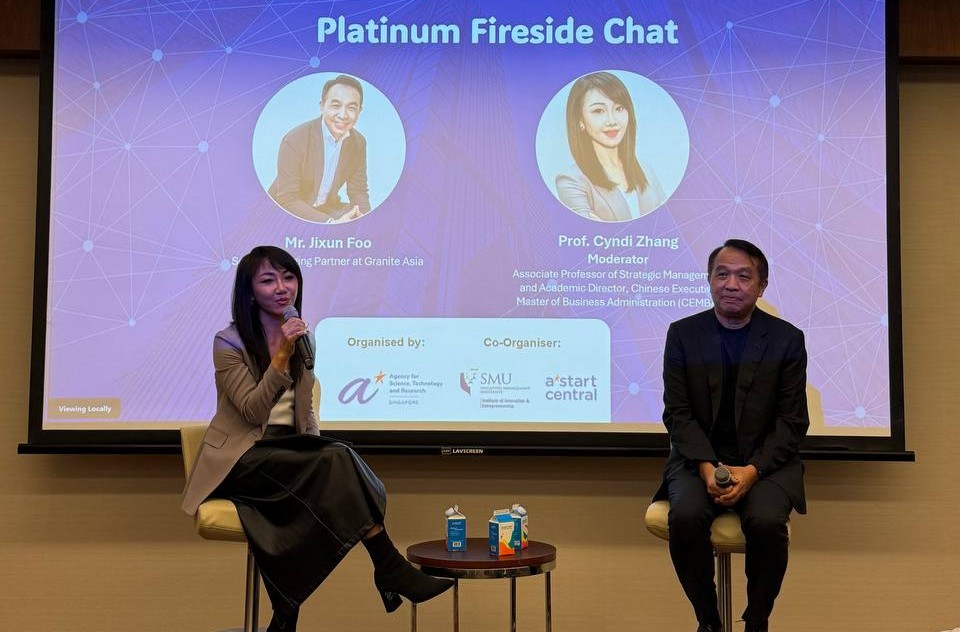
SMU Institute of Innovation and Entrepreneurship hosted a Tech Collider session that cut through the noise around artificial intelligence, not with predictions or platitudes, but with the kind of hard-earned perspective that only comes from having been in the room when the decisions were made. Foo Jixun, Senior Managing Partner of Granite Asia, spoke candidly about where AI is genuinely transforming work, where the hype falls flat, and what it means to build a career — or a company — in this moment.
The conversation, moderated by Prof Cindy Zhang, Associate Professor of Strategic Management and Academic Director of the Chinese Executive MBA programme, drew students into a discussion that was equal parts reality check and forward map.
On AI and the future of consulting: nuance over automation
One of the session's sharpest moments came when Prof Zhang asked what's overhyped about generative AI — and what's being missed. The answer was grounded and specific.
The narrative that AI will kill consulting, he argued, rests on a shallow reading of what consulting actually is. The work, he explained, is only getting harder. Clients can now handle more surface-level research themselves, which means the problems that reach a consultant's desk are the ones that are genuinely complex — the kind that require stakeholder management, contextual judgment, and expertise that no model was trained on.
What he believes is genuinely undervalued: the combination of AI with deep sector expertise. The insight buried inside a specific industry — the informal knowledge, the unspoken rules, the things practitioners know but never write down — is precisely where human judgment becomes irreplaceable. "If you've done that internship, or worked at a company in a specific sector, you know all these little things. That's where the real opportunity lies."
"The narrative that AI will kill consulting,
rests on a shallow reading of what consulting actually is"
On what's changed since BCG: from individual contributor to AI director
Foo's reflection on the evolution of consulting careers offered one of the session's more striking reframes. When he joined BCG fifteen years ago, the first few years were spent as an individual contributor — gathering information, building slides, doing the groundwork. That role, he said, is essentially gone.
"What you'll be doing from day one is steering teams — and not so much teams of other people, but teams of AI agents." The expectation now is that a junior hire can already think about what needs to be done, translate that into instructions for AI, evaluate the output, refine it, and deliver. That's a higher baseline than before. But the upside is real: graduates entering consulting today will be doing actual strategy work far earlier. "Partners want to speed up the first promotion a lot — they know way quicker who can operate at consultant level, because everyone is almost forced to already operate at that next level when they join."
On what to prioritise early in your career: work with people who have standards
When asked whether, as a student, he would go straight into building a startup or join a company first, Foo's answer was deliberate. The framing isn't corporate versus startup, he said — it's about the quality of the environment.
"What matters most, in my view, is you join somewhere where there are highly demanding, highly successful people who have really high standards for excellence. What you want to do in your first years is learn — how to work with discipline, how to break down complex problems, how to get to results very fast."
That foundation, he argued, is what makes entrepreneurship sustainable rather than chaotic. You learn what "great" looks like before you try to build it yourself. "I'm now an entrepreneur — it's beautiful. But I would say you have this as a basis, and then you come across a problem that is keeping you awake at night and that you feel you are the right person to solve. Then you take all of that and you know: this is how I should work — with fewer mistakes, more speedy execution, and knowing what level to reach for. Not just good, but really great and exceptional."
"What you want to do in your first years is learn — how to work with discipline,
how to break down complex problems, how to get to results very fast."
Key Takeaways
Three threads ran through Foo Jixun's perspective across the session:
The first is that AI doesn't replace judgment — it raises the stakes for it. As more surface-level work becomes automatable, the value of human discernment increases, not decreases. The people who will thrive are those who can evaluate AI output critically, not just generate it fluently.
The second is that sector-specific expertise is an underrated moat. The contextual knowledge that lives inside an industry — the things practitioners understand but haven't written down — is exactly what AI lacks. For students still building their careers, developing depth in a domain is not a retreat from the AI age. It's an advantage within it.
The third is that early-career decisions should be optimised for learning, not prestige. The company or firm matters less than the standards it holds. Working alongside people who know what excellent looks like — and who demand it — is the fastest way to calibrate your own sense of what you're building toward.
The Tech Collider series, hosted by SMU's Institute of Innovation and Entrepreneurship, brings together founders, investors, and industry leaders for candid conversations with the SMU student and entrepreneurship community.